What Is Fan Service in Anime? A Complete Guide to One of the Most Debated Topics in the Community
Fan service in anime refers to scenes, character designs, or moments created primarily to entertain or gratify the audience rather than advance the story.
If you’ve watched enough anime, you’ve encountered it. A scene that seems to exist purely for audience gratification rather than story purpose. A camera angle that lingers a little too long. A hot springs episode that conveniently requires every character to be undressed. A battle that somehow results in clothing destruction.
That’s fan service — and depending on who you ask, it’s either a beloved tradition, a harmless bit of fun, a lazy writing crutch, or a serious problem with the medium.
Fan service is one of the most talked-about, argued-about, and misunderstood concepts in anime fandom. It appears in shows ranging from shonen battle epics to romantic comedies to serious psychological dramas. It has its passionate defenders and its vocal critics. And it means something different today than it did when the term was first coined.
This article is a thorough, honest look at what fan service actually is, where it came from, how it works, why it exists, and what the ongoing debate around it really means.
The Basic Definition: What Is Fan Service?
Fan service, in its simplest definition, refers to content in an anime — or any other media — that exists primarily to please or gratify the audience rather than to advance the plot, develop characters, or serve the story in any meaningful narrative way.
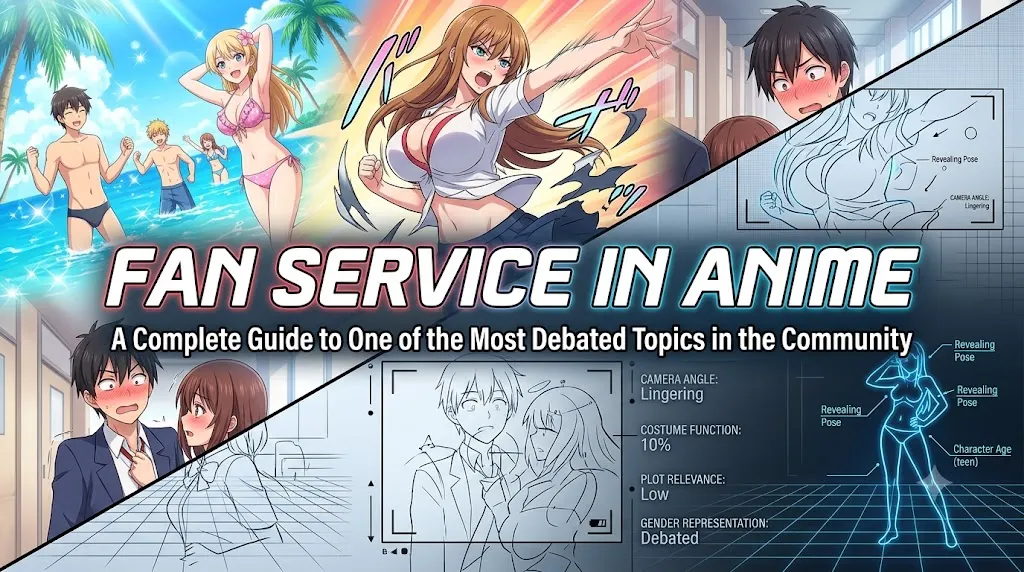
The term “fan service” comes from the Japanese word ファンサービス (fan sābisu), and it originally had a broader meaning than it does in Western fan discussions today. In Japanese entertainment culture, “fan service” once referred to any kind of extra content created specifically to delight fans — bonus scenes, cameos, Easter eggs, callbacks to earlier moments in a series, or special interactions between beloved characters. It was a neutral or even positive term.
Over time, particularly as the term crossed into Western anime fandom, its meaning narrowed considerably. Today, when most people say “fan service,” they are usually referring specifically to sexualized or titillating content — scenes, shots, or character designs created to appeal to the audience’s attraction to the characters rather than to serve the story.
This is the definition we’ll primarily be working with in this article, though we’ll also address the broader usage where relevant.
What Does Fan Service Actually Look Like?
Fan service takes many forms, and recognizing it is usually pretty easy once you know what to look for. Some of the most common types include:
Upskirt shots and revealing angles: Camera angles that focus on characters’ underwear, cleavage, or other body parts, often in situations where the framing seems designed purely to show the audience something rather than establish any visual information relevant to the scene.
Beach, hot spring, and pool episodes: These have become so common they’re practically their own genre. An episode set at a beach or hot springs exists primarily to show the characters in swimsuits or without clothing while technically maintaining plausibility within the story world. These episodes rarely advance the plot in any significant way.
Clothing destruction: Particularly common in action anime, battles that conveniently shred female characters’ clothing while leaving male characters largely unaffected. The physics of this tend to be highly selective.
Jiggle physics: An animation technique — or rather, a deliberate choice — where female characters’ breasts move in exaggerated, physically unrealistic ways during action sequences or even while simply walking.
Accidental intimate contact: A staple of romantic comedy anime. The protagonist trips and lands with his face in a girl’s chest, or accidentally walks in on a character changing, or grabs something that turns out to be something else. These moments exist almost entirely to create titillation within a comedically plausible context.
Transformation sequences: Common in magical girl anime, where characters undergo extended, detailed transformation sequences that involve nudity or near-nudity as they change into their powered-up forms.
Fanservice costume design: Characters — predominantly female — wearing outfits that seem designed more for audience appeal than for any in-world practicality. Armor that covers nothing, school uniforms with improbably short skirts, battle costumes that expose maximum skin.
Non-sexual fan service: Character interactions that fans have specifically wanted to see — a beloved rival finally acknowledging the protagonist, a long-awaited reunion between two characters, a callback to an iconic earlier scene. This is fan service in the broader, original sense of the term, and it’s generally viewed positively by most fans.
A Brief History of Fan Service in Anime
Fan service didn’t appear out of nowhere. Understanding its history helps explain why it’s so deeply embedded in anime as a medium.
The Roots in Manga and Early Anime
Sexually suggestive content has been part of Japanese popular visual culture for a very long time — far longer than anime itself. Shunga, the tradition of erotic woodblock prints, dates back centuries. Japan has a long cultural history of treating erotic art as a legitimate form of entertainment rather than something shameful or hidden.
When manga began to develop as a mass market medium in the postwar era, ecchi content (mildly sexual, suggestive material — more on this term shortly) was part of the landscape from early on. Anime, which grew out of manga culture and adapted many of the same properties, inherited these tendencies.
The 1980s and the OVA Era
The rise of the Original Video Animation format in the 1980s was particularly significant for fan service. OVAs — anime released directly to home video rather than broadcast on television — faced less regulatory restriction than TV anime. This freedom allowed creators to include more explicit content, and many OVAs leaned heavily into fan service as a selling point.
This period established many of the conventions that persist in anime today and created a market expectation in certain genres that fan service was part of the package.
The 1990s: Fan Service Goes Mainstream
As anime began to reach wider audiences both in Japan and internationally, fan service became increasingly normalized across mainstream genres. Shows like Tenchi Muyo!, which featured a harem of female characters competing for one male protagonist’s affection, helped establish templates that dozens of subsequent series would follow.
Even series not primarily aimed at fan service began incorporating it regularly — the famous filler content in long-running shonen series often included beach episodes or comedic intimate situations as a way to fill time between major story arcs.
The 2000s and Beyond: Intensification and Reaction
Through the 2000s and 2010s, fan service became both more prevalent and more extreme in certain corners of the market. The isekai genre — stories about protagonists transported to fantasy worlds — often featured elaborate harem dynamics and increasingly revealing character designs.
At the same time, a more vocal critical response began to develop — both within Japan and in international fandom — questioning the ubiquity of fan service, particularly as it related to female character design and the treatment of young-looking characters.
This tension between fan service as commercial tradition and fan service as a problematic element of the medium defines much of the contemporary debate.
Ecchi, Hentai, and Where Fan Service Fits
These terms often get confused, so it’s worth clarifying how they relate to each other.
Fan Service is the broad category of content that exists primarily for audience gratification. It can range from a slightly suggestive camera angle to extended scenes of near-nudity. It appears in series of all ratings and audience targets.
Ecchi (the Japanese pronunciation of the letter “H,” itself shorthand for hentai as a general concept, though confusingly now distinct from it) refers to anime and manga with a persistent focus on mildly sexual, suggestive content — nudity may be shown but nothing explicitly sexual. Shows classified as ecchi are essentially built around fan service as a core feature rather than an occasional element. High School DXD, To Love Ru, and Monster Musume are well-known examples.
Hentai refers to explicitly pornographic anime and manga. This is not fan service in the way the term is commonly used — hentai is a distinct category of adult content with its own production, distribution, and audience. Mainstream anime studios do not produce hentai.
The spectrum matters because “fan service” can mean a single mildly suggestive shot in an otherwise serious anime, or it can mean an ecchi series where suggestive content is the entire premise. These are very different things that often get conflated in discussions, which is part of why the debate around fan service tends to generate so much heat.
Why Does Fan Service Exist? The Commercial Logic
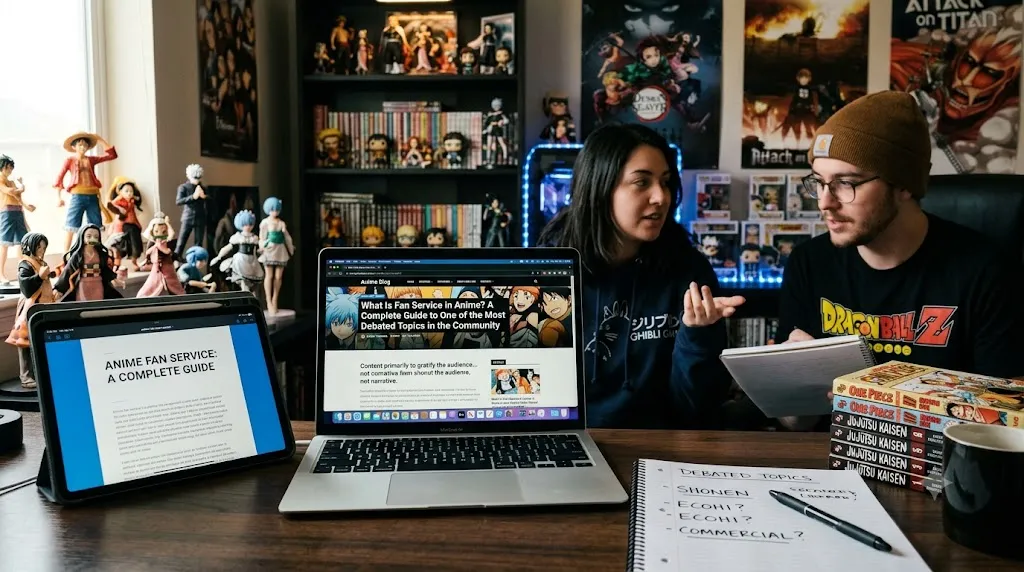
Fan service isn’t an accident and it isn’t purely a creative choice. It exists because it works commercially. Understanding the economics helps explain why it persists even as criticism of it grows.
The Otaku Market
The term “otaku” originally carried negative connotations in Japan — it referred to extremely dedicated fans of anime, manga, and related media who were often seen as socially isolated. Over time the term has been partially reclaimed, but the consumer behavior it describes remains significant.
The hardcore otaku market — devoted fans who buy Blu-rays, figures, merchandise, and other collectibles — has historically been one of the most reliable revenue streams for anime studios. And fan service, particularly in ecchi and harem shows, has reliably driven this market. A character with an appealing design generates figure sales. A beach episode generates Blu-ray purchases because the home video release often restores content that was partially censored in the broadcast version.
This economic model has shaped production decisions for decades. Even when studios or directors might prefer not to include fan service, the commercial calculation often points toward inclusion because it serves a proven, reliable market.
Demographic Targeting
Anime is produced for specific demographic categories: shounen (young male readers), shoujo (young female readers), seinen (adult men), josei (adult women), and others. The demographic a show targets influences its content significantly.
Shows targeting young male demographics have historically included more heterosexual fan service — revealing female character designs, suggestive situations, and romantic comedy tropes. Shows targeting adult male demographics in the seinen category can go further.
It’s also worth noting that fan service aimed at female audiences exists and is growing — shows featuring attractive male characters in appealing situations, intimate scenes between male characters (a genre known as Boys’ Love or BL), and other content designed specifically for female fans. This type of fan service is sometimes overlooked in discussions that focus primarily on the male-targeted variety.
The Blu-ray Bonus Model
One particularly significant commercial mechanism in Japanese anime is the Blu-ray bonus. Broadcast versions of anime episodes are often partially censored — suggestive scenes may have strategic light beams, steam, or black bars covering potentially explicit content. The home video release removes this censorship.
This creates a financial incentive built directly into the production model: include content that will be censored for broadcast, then release the uncensored version on home video to drive sales. Series that use this model aggressively are essentially selling their fan service twice — once to the broadcast audience and once to the Blu-ray purchaser.
Fan Service and Character Design: The Female Character Problem
One of the most persistent criticisms of fan service in anime is its unequal application — specifically, the way it shapes the design and presentation of female characters relative to male ones.
In many anime, female characters are designed primarily with audience appeal in mind, while male characters are designed with narrative role in mind. A female character’s first introduction might emphasize her body shape and clothing before anything else. Her costume might be impractical or revealing in ways that male characters’ costumes never are. Her character arc might be subordinated to her role as a love interest or as an object of fan service.
This doesn’t apply to all anime — the medium is vast, and there are countless series that treat female characters with depth, complexity, and agency. But the pattern is real enough to be statistically obvious across certain genres and demographics.
The Age Problem
Perhaps the most serious and widely acknowledged problem with certain types of anime fan service is its application to characters who appear to be, or are stated to be, underage.
This is not a marginal phenomenon in certain corners of anime. Characters who are explicitly described as teenagers, or who have childlike visual designs, are sometimes presented in sexualized fan service contexts. Japanese legal and cultural standards around this content differ from those of many Western countries, which creates friction when anime is consumed by international audiences.
This aspect of anime fan service has drawn serious criticism not just from Western audiences but from within Japan, and it represents a genuine ethical problem that the industry continues to navigate imperfectly. Many Western streaming platforms and distributors have policies around this content. It’s also worth noting that many anime fans — including those who are generally positive about fan service — draw a clear line at this specific category.
The Critical Debate: Arguments For and Against
Fan service generates some of the most heated arguments in anime fandom. Here are the strongest versions of both sides.
The Case for Fan Service
Fan service is part of anime’s identity. The medium has always included this type of content. Attempting to excise it entirely would fundamentally change what anime is and has been for decades.
It serves a real audience. There are large numbers of fans who genuinely enjoy fan service and seek out shows that include it. Their preferences are legitimate. Entertainment is allowed to cater to different tastes.
Many fan service shows are honest about what they are. An ecchi series isn’t pretending to be something it isn’t. Viewers who don’t enjoy that content can simply watch something else. The presence of fan service in one show doesn’t affect shows that don’t include it.
Fan service doesn’t have to be degrading. When handled with awareness and a sense of humor, fan service can be part of shows where female characters are still well-developed, capable, and respected. The two things aren’t inherently incompatible.
Some of the most beloved anime contain significant fan service. Neon Genesis Evangelion, Kill la Kill, and many other critically acclaimed series include substantial fan service elements while also being artistically ambitious, thematically rich works. Dismissing them because of fan service misses what makes them interesting.
The Case Against Fan Service
It frequently reduces female characters to objects. When a character’s primary function in multiple scenes is to be looked at rather than to do or say anything of significance, it signals something about how the creators view that character’s purpose.
It interrupts narrative momentum. A serious scene undercut by a gratuitous camera angle is a worse scene than it would have been otherwise. Fan service that exists at the expense of storytelling makes shows worse.
The normalization of certain content is genuinely problematic. Repeated exposure to specific body standards, specific gender dynamics, and specific presentations of female characters as available objects of desire has cultural effects. Entertainment doesn’t exist in a vacuum.
The age issue is serious and not addressed well by the industry. The sexualization of characters with childlike designs or explicitly teenage ages is a genuine problem that criticism shouldn’t shy away from naming clearly.
It often signals lazy writing. When a show relies on fan service to maintain audience engagement, it’s often a sign that the writers don’t have enough confidence in their characters and story to hold attention on their own merits.
Fan Service Done Well vs. Fan Service Done Poorly
Not all fan service is created equal, and making this distinction is important for a nuanced understanding of the topic.
Fan service done well tends to be: consistent with the tone of the show, applied to characters who are otherwise well-developed, used sparingly enough that it doesn’t dominate the viewing experience, and occasionally self-aware or comedic in a way that acknowledges what it’s doing.
Kill la Kill is the most discussed example of fan service used self-consciously as a thematic element. The show’s extreme costume design is framed explicitly within its themes about clothing, power, shame, and freedom. The fan service isn’t incidental — it’s part of what the show is arguing. Whether this justification succeeds is a matter of legitimate debate, but the intent is clearly different from fan service that’s simply inserted without thought.
Fan service done poorly tends to be: inserted into scenes with no tonal awareness, applied to characters who have no other substantive role in the narrative, so frequent that it becomes the show’s dominant characteristic rather than an occasional element, and focused on characters presented as very young.
The difference often comes down to whether the creators are thinking about their female characters as people who sometimes appear in suggestive situations, or as fan service delivery mechanisms who occasionally have dialogue.
How Different Genres Handle Fan Service
Fan service manifests very differently across anime genres, and understanding these patterns helps set expectations.
Shonen Anime
Long-running shonen series — Naruto, Bleach, One Piece, Dragon Ball — tend to include relatively mild fan service that appears periodically rather than constantly. Beach episodes, occasional revealing outfits, some physical comedy involving intimate contact. This content is part of the fabric of the genre without being the genre’s defining feature.
Harem and Romantic Comedy Anime
These genres often center on fan service as a primary draw. The premise — one protagonist surrounded by multiple attractive potential partners who compete for their affection — generates constant opportunities for fan service situations. Series like Sword Art Online, Date A Live, and The Quintessential Quintuplets fall into various points on this spectrum.
Isekai Anime
The isekai genre has become particularly associated with fan service in recent years. Many isekai series combine the harem dynamic with power fantasy elements, creating protagonists who are very good at everything and surrounded by adoring female characters. The genre has become somewhat self-satirizing on this point, with parody isekai like KonoSuba deliberately mocking these conventions.
Magical Girl Anime
Fan service in magical girl anime primarily appears in transformation sequences, which have a long tradition of involving the character’s body during the power-up process. This ranges from abstract, stylized depictions in classic series to more sexualized versions in certain later entries in the genre.
Sports and Slice of Life Anime
These genres tend to have fan service that’s more incidental and less central — swimsuit scenes during summer training arcs, comedic accidents, characters in casual home clothing. It’s present but rarely the point.
Serious Thriller and Horror Anime
Fan service appears even here, often controversially. Psychological series or dark horror anime that include gratuitous fan service moments often receive the harshest criticism precisely because the tonal mismatch is so jarring.
The Evolution of the Conversation
The discourse around fan service in anime has evolved significantly over the past decade, and it continues to change.
The international expansion of anime audiences — accelerated dramatically by the rise of streaming platforms like Crunchyroll, Netflix, and Funimation — has brought the medium to audiences with very different expectations and cultural contexts than the original Japanese market. This has intensified the conversation around fan service and created more diverse voices in the debate.
Within Japan, there has been growing conversation about gender representation in anime and manga, particularly as Japanese society more broadly grapples with questions about gender equality and workplace culture.
Some creators have responded by producing anime with more consciously balanced or subversive approaches to gender — female protagonists with genuine agency, shows that apply the “attractive character” lens equally to male and female characters, series that use fan service tropes deliberately to critique or subvert them.
At the same time, the market for traditional fan service content hasn’t gone anywhere. The commercial model that supports it remains intact, and a large audience continues to engage with it willingly.
How to Think About Fan Service as an Anime Fan
If you’re new to anime, or if you’re trying to figure out how to engage with this topic, here are some genuinely useful frameworks:
Context matters enormously. Fan service in a show built around it is different from fan service dropped into a serious narrative. Evaluate it in context before forming a judgment.
You don’t have to like it to watch the show. Many of the best anime contain elements that some viewers find uncomfortable. Being able to engage critically with content you don’t fully endorse is a sign of mature viewership.
You’re also allowed to simply not watch content you dislike. Not every criticism requires you to remain engaged with its object. If fan service in a particular show ruins your enjoyment, watching something else is a completely valid choice.
The age issue is a legitimate line. Most serious fans, regardless of their general feelings about fan service, recognize that sexualized content involving characters presented as children or young teenagers is categorically different from other fan service. It’s okay to treat this as a firm boundary.
Fan service and good storytelling aren’t mutually exclusive — but they often are in practice. The best anime tend to be the ones where creators are most focused on story and character. This doesn’t mean good anime can’t contain fan service, but it does mean that heavy fan service is often a signal about where the creative priorities were.
Final Thoughts
Fan service in anime is not a simple topic, and anyone who tells you it is hasn’t thought about it carefully enough.
It is simultaneously a legitimate form of entertainment that millions of people enjoy, a commercial mechanism deeply embedded in how anime is produced and sold, a creative tool that ranges from thoughtless to genuinely purposeful depending on how it’s used, and in certain specific manifestations, a genuine ethical problem that the industry needs to continue addressing.
The conversation about fan service is really a conversation about much bigger questions: Who is anime for? How should entertainment represent gender? What responsibilities do creators have to their audiences? And how do we hold space for personal taste while also thinking critically about the media we consume?
These are worthwhile questions. They don’t have simple answers. But asking them thoughtfully — rather than dismissing fan service wholesale or defending it reflexively — is how the conversation actually moves forward.
Anime is one of the most creative, varied, and emotionally powerful storytelling mediums in the world. Fan service is one part of it — sometimes a charming part, sometimes a lazy part, sometimes a problematic part. Understanding it clearly is part of understanding the medium clearly.
And that’s always worth doing.
Frequently Asked Questions
Fan service refers to scenes, character designs, or moments created primarily to entertain or appeal to the audience rather than advance the story.
No. While the term is often associated with sexualized content, fan service can also include cameos, character reunions, Easter eggs, or other moments designed to delight fans.
No. Fan service is a broad concept that can appear in many anime genres, while ecchi specifically focuses on suggestive or mildly sexual content as a major part of the series.
Anime creators may use fan service to entertain viewers, appeal to a target audience, increase merchandise sales, or add humor and lighthearted moments to a series.
Not necessarily. Some viewers enjoy it, while others feel it distracts from storytelling. Whether fan service improves or hurts an anime often depends on how it is used within the story.
Sources
- Japan Foundation. Japanese Pop Culture and Anime Resources.
- Susan J. Napier. Anime from Akira to Howl’s Moving Castle: Experiencing Contemporary Japanese Animation. Palgrave Macmillan.
- Patrick W. Galbraith. The Moe Manifesto: An Insider’s Look at the Worlds of Manga, Anime, and Gaming. Tuttle Publishing.
- Jonathan Clements. Anime: A History. British Film Institute (BFI).
- Marc Steinberg. Anime’s Media Mix: Franchising Toys and Characters in Japan. University of Minnesota Press.
- Thomas Lamarre. The Anime Machine: A Media Theory of Animation. University of Minnesota Press.
- Anime News Network. https://www.animenewsnetwork.com/
- MyAnimeList Anime Database. https://myanimelist.net/
- Crunchyroll News. https://www.crunchyroll.com/news
- TV Tropes. Fanservice. https://tvtropes.org/pmwiki/pmwiki.php/Main/Fanservice