What Is Isekai? A Complete Guide to the Popular Anime Genre
If you’ve spent any time around anime, manga, or Japanese light novels, you’ve definitely seen the word isekai thrown around. But what exactly is it, and why is it everywhere?
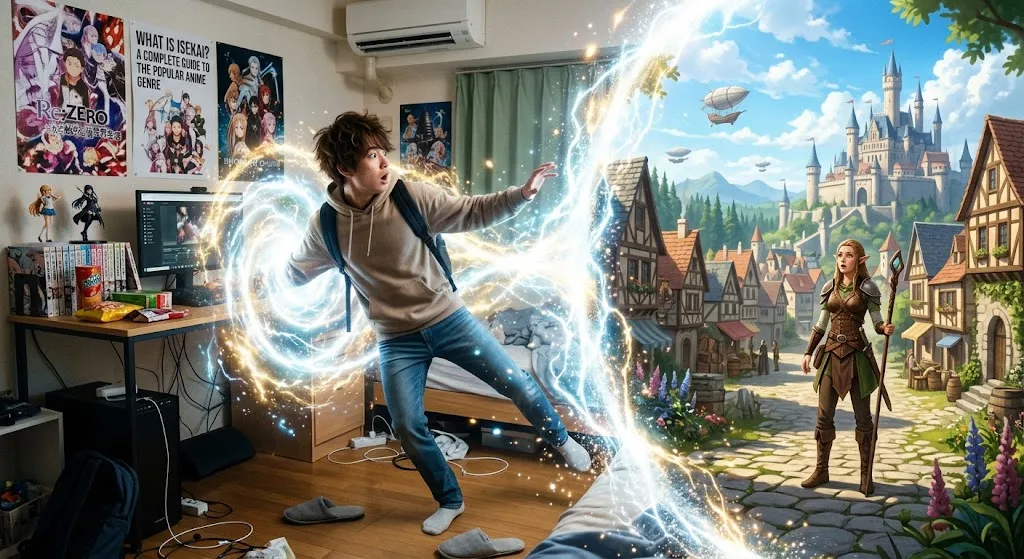
Isekai (異世界) literally means “another world” or “different world” in Japanese. In modern storytelling, it usually describes stories where an ordinary person leaves their everyday life and ends up in a completely different reality—often through reincarnation, being summoned, or stumbling through some kind of portal.
That new world might be a classic fantasy kingdom with magic and monsters, a game-like universe with levels and skills, or something totally unique with its own rules and culture.
At its core, isekai asks one simple but powerful question: What if you could start over in a completely different world?
That premise gives creators a ton of freedom. Isekai stories can blend fantasy, action, romance, comedy, adventure, mystery, slice-of-life, cooking, farming, politics—almost anything you can imagine.

What Does “Isekai” Mean?
The word 異世界 (isekai) is made up of two parts: i (different) and sekai (world). In everyday Japanese, it can just mean “another world,” but in pop culture it’s become shorthand for a specific kind of story.
An isekai tale usually starts with a protagonist living a normal life on Earth, then suddenly finding themselves in a completely different world.
That transition can happen in a few common ways:
- They die and are reincarnated in another world
- They’re summoned by people from another world
- They’re physically transported through a portal or strange event
- They slip into an alternate reality
- They enter or become trapped in a game-like or alternate reality
A big part of what makes these stories work is the contrast between the character’s old life and their new surroundings. They might bring memories, skills, or knowledge from Earth, which can lead to both funny and dramatic moments.
The Two Most Common Types of Isekai
Many Isekai stories can be broadly grouped into two familiar patterns: reincarnation and transportation or summoning.
1. Reincarnation (Tensei)
In a reincarnation Isekai, the protagonist is reborn into another world, often after dying in their original life.
Sometimes they’re born as a baby and grow up there; other times the story skips ahead. The key detail is that they usually keep their memories from their past life.
That gives them an interesting edge: they know things people in the new world don’t—whether it’s modern science, business ideas, or just how the “real world” works.
Well-known examples:
- Mushoku Tensei: Jobless Reincarnation
- That Time I Got Reincarnated as a Slime
- The Saga of Tanya the Evil
- My Next Life as a Villainess: All Routes Lead to Doom!
The “Truck-kun” Meme
Fans love to joke about “Truck-kun,” the mythical truck that supposedly sends countless characters to their next life. It became a meme because some reincarnation stories do start with a traffic accident, even though plenty of modern isekai use very different setups.
It’s a fandom in-joke, not a rule of the genre.
2. Transportation or Summoning (Ten’i)
In transportation or summoning Isekai, the protagonist moves from their original world into another world without being reincarnated there.
Common triggers include:
- A magical summoning ritual
- A mysterious portal
- A strange artifact
- A supernatural event or spell
- Some other unexplained phenomenon
Popular examples:
- Re:ZERO -Starting Life in Another World-
- The Rising of the Shield Hero
- KonoSuba: God’s Blessing on This Wonderful World!
These stories often focus on the character learning the rules of the new world and figuring out how to survive and adapt.
Common Isekai Tropes and Story Elements

Isekai isn’t locked into one formula, but certain patterns show up so often they’ve become genre staples.
The “Cheat” Ability
Many protagonists get some kind of overpowered ability after arriving in the new world.
This could be insane magical power, genius-level intelligence, superhuman strength, or a unique skill no one else has.
It leans into wish-fulfillment, but not every isekai hero is unstoppable. Some stories intentionally make their main characters weak, inexperienced, or vulnerable to raise the stakes.
RPG and Game Mechanics
A lot of isekai worlds borrow heavily from role-playing games. You might see:
- Levels and experience points
- Skills and skill trees
- Character stats (strength, magic, agility, etc.)
- Quests and adventurer guilds
- Item inventories and equipment slots
- Game-like interfaces or status screens
These mechanics help audiences quickly understand how the world works. That said, an isekai doesn’t need game systems to count as isekai—many don’t use them at all.
A New Identity
Reincarnation stories often give protagonists a completely new identity.
They might be reborn into a different family, social class, or even as a non-human species (slimes, swords, monsters, you name it).
This lets creators explore themes like identity, growth, relationships, and what it really means to get a second chance at life.
Modern Knowledge in a Fantasy World
Some protagonists use what they know from Earth to solve problems in the new world.
For example, they might:
- Introduce modern cooking techniques
- Start new businesses or economic systems
- Improve farming or engineering methods
- Reorganize armies, governments, or guilds
This trope keeps the character’s old life relevant even after they’ve moved on.
Reverse Isekai
Reverse isekai flips the usual setup: instead of someone from Earth going to a fantasy world, a character from a fantasy or supernatural world ends up on modern Earth.
The story then explores how someone used to magic, monsters, or royal duties handles everyday problems like jobs, rent, technology, and social norms.
A famous example: The Devil Is a Part-Timer!
Is Sword Art Online an Isekai?
Sword Art Online often gets mentioned alongside isekai, but its status is debatable.
The series is set in a virtual reality MMORPG where players are trapped inside a digital game world. Because the characters enter a reality that’s completely different from their normal lives, it shares some DNA with isekai.
However, it’s also frequently classified as science fiction, virtual reality, or game-based anime rather than traditional isekai.
So the most accurate take: Sword Art Online is closely related to isekai, but it’s not a straightforward example of the genre.
How Did Isekai Become So Popular?
The idea of traveling to another world is far older than modern anime. Cultures around the world have told stories about magical lands, supernatural realms, and portal adventures for centuries. What changed is how Japanese creators shaped and popularized it as a distinct genre.
Early Precursors
Japanese folklore has tales like Urashima Tarō, about a fisherman who visits an underwater palace and returns to find time has passed differently.
Western literature has similar vibes—think Alice’s Adventures in Wonderland or The Chronicles of Narnia. These aren’t “isekai” in the modern sense, but they’re clear ancestors of portal-fantasy storytelling.
The 1990s: Building the Template
In the 1990s, several anime and manga series helped lay the groundwork for what would become modern isekai:
- Fushigi Yûgi
- Magic Knight Rayearth
- The Vision of Escaflowne
These showed how traveling between worlds could support romance, adventure, fantasy, drama, and character growth all at once.
The 2010s: The Isekai Boom
Isekai really exploded in the 2010s.
The growth of Japanese web-novel platforms such as Shōsetsuka ni Narō, together with the popularity of light novels, helped creators experiment with reincarnation, summoning, game-like worlds, and overpowered protagonists.
Anime adaptations then brought these stories to global audiences. Big titles from this era include:
- Re:ZERO -Starting Life in Another World-
- Overlord
- KonoSuba: God’s Blessing on This Wonderful World!
- That Time I Got Reincarnated as a Slime
- The Rising of the Shield Hero
Modern Isekai: Beyond the Basics
Today, isekai has moved far beyond “hero shows up in fantasy world and fights monsters.”
Creators now use the basic premise for:
- Comedy and romance
- Dark fantasy and horror
- Slice-of-life and everyday drama
- Cooking, farming, and business sims
- Politics, mystery, and parody
Examples:
- Restaurant to Another World centers on food and hospitality.
- Uncle from Another World explores what happens when someone returns from another world to modern Japan.
That variety is a big reason the genre keeps attracting new fans.
Why Is Isekai So Popular?
Isekai works because it taps into several powerful storytelling strengths.
1. The Appeal of a Fresh Start
Many protagonists start with boring, difficult, or frustrating lives. Getting sent to another world gives them a chance to start over.
The fantasy of leaving behind an unsatisfying life and finding new purpose, relationships, and abilities is emotionally compelling—especially when the character actually grows and changes.
2. Escapism and Wish Fulfillment
Isekai often leans into escapism.
The main character might:
- Discover magical powers
- Become important to a new society
- Develop extraordinary skills
- Finally feel like they belong
But the best isekai don’t rely only on easy wish fulfillment. Many also deal with loneliness, trauma, responsibility, failure, sacrifice, and real personal growth.
3. Natural World-Building
Because the protagonist usually knows nothing about the new world, the audience learns alongside them.
Instead of dumping lore all at once, the story can reveal:
- Magic systems
- Political structures
- Cultures and histories
- Geography and rules
…as the character encounters them. That makes complex worlds easier to digest.
4. Almost Unlimited Genre Possibilities
The basic isekai premise can be combined with nearly any other genre.
An isekai series can be:
- An action adventure
- A romantic comedy
- A dark fantasy or horror story
- A survival thriller
- A mystery or political drama
- A cozy slice-of-life or cooking show
- A parody of the genre itself
That flexibility lets creators put their own spin on a familiar idea, which keeps the genre fresh.
Isekai vs. Fantasy: What’s the Difference?

Fantasy is a broad genre that can include magic, supernatural creatures, imaginary kingdoms, mythical beings, and entirely fictional worlds.
Isekai is more specific: it’s defined by a protagonist moving from their original world into another distinct world or reality.
For example:
- A character born and raised in a magical kingdom is part of a fantasy story—but not necessarily isekai.
- A person from modern-day Tokyo who gets transported to that same kingdom? That’s very likely isekai.
In simple terms:
- Fantasy describes the type of world or setting.
- Isekai describes the relationship between the protagonist’s original world and the new one they enter.
The two can overlap heavily, but they’re not the same thing.
Frequently Asked Questions About Isekai
“Isekai” means “another world” or “different world” in Japanese. In anime, manga, and light novels, it usually refers to stories where a protagonist moves from their original world into another distinct reality.
The two most common types are:
Reincarnation: The protagonist dies and is reborn in another world, often keeping their memories.
Transportation/Summoning: The protagonist is moved to another world while still alive, via portals, rituals, or strange events.
No. Isekai appears in anime, manga, light novels, web novels, and video games. The broader idea of traveling to another world also shows up in fantasy literature from many cultures.
No. Overpowered heroes are common, but many isekai stories feature characters who struggle with weaknesses, tough circumstances, unfamiliar environments, or powerful enemies.
It’s often discussed alongside isekai because the characters enter a virtual world, but its classification is debated. It’s also commonly described as a virtual-reality, science-fiction, and game-based series.
Reverse isekai flips the usual premise: a character from a fantasy or supernatural world arrives on modern-day Earth instead of a modern person traveling to a fantasy world.
No. Magic is common but not required. The new world can be technological, supernatural, game-inspired, futuristic, or otherwise fundamentally different from the protagonist’s original reality.
Not always. While many protagonists remain in the new world for most of the story, some narratives involve returning to Earth, traveling between worlds, or dealing with life after coming home.
Final Thoughts
So, what is isekai?
At its simplest, isekai is a storytelling concept centered on a protagonist who leaves their original reality and enters another world—through reincarnation, transportation, summoning, or some other unusual means.
What makes the genre so flexible is that this basic premise can support almost any kind of story. One series might follow an overpowered hero battling monsters, while another focuses on romance, cooking, farming, comedy, politics, or everyday life.
From its early influences and 1990s roots to the major growth of the 2010s and today’s increasingly creative variations, isekai keeps evolving.
In the end, the appeal comes down to a timeless question:
What if you could leave your ordinary world behind and begin an entirely new life somewhere else?
About the Author
Tsumino Blog is an anime and manga-focused publication covering popular series, genres, characters, trends, and Japanese pop culture. The editorial team creates accessible guides and informative articles designed to help readers discover new anime and manga while better understanding the stories, themes, and terminology behind them. From Isekai and fantasy to manga and light novels, Tsumino Blog provides straightforward content for both longtime fans and readers who are just beginning to explore the world of Japanese entertainment.
Sources
- Nippon.com — “Isekai” Boom Offers Better Lives in Other Worlds
https://www.nippon.com/en/japan-topics/g01206/ - Japanese with Anime — Japanese Language and Anime Terminology
Japanese with Anime - Sword Art Online Official Portal — Aincrad Story
Sword Art Online Official Portal - Sword Art Online Official Portal — Aincrad Introduction
Sword Art Online Official Portal - Japanese with Anime — Manga and Anime Terminology
Japanese with Anime